The Use of De (的) in Chinese: A Complete Guide for Beginners and Intermediate Learners
Introduction
The use of de (的) in Chinese often seems straightforward at first glance, but in practice it can turn out to be a more demanding grammatical topic for learners. It is introduced very early on, often in the very first lessons, yet its underlying logic is usually understood much later. The reason is simple: 的 does not have a single, clear translation. Instead, it takes on several functions that, in English and other European languages, are expressed through cases, possessive adjectives, prepositions, or even entire relative clauses.
In this article, we focus exclusively on the particle 的 (de), not 得 (de) or 地 (de). The aim is to bring together all its most important uses in one place, in a way that is clear, logical, and practical for both beginners and intermediate learners of Chinese.
The use of de (的) in Chinese: what the character 的 means and how it is used
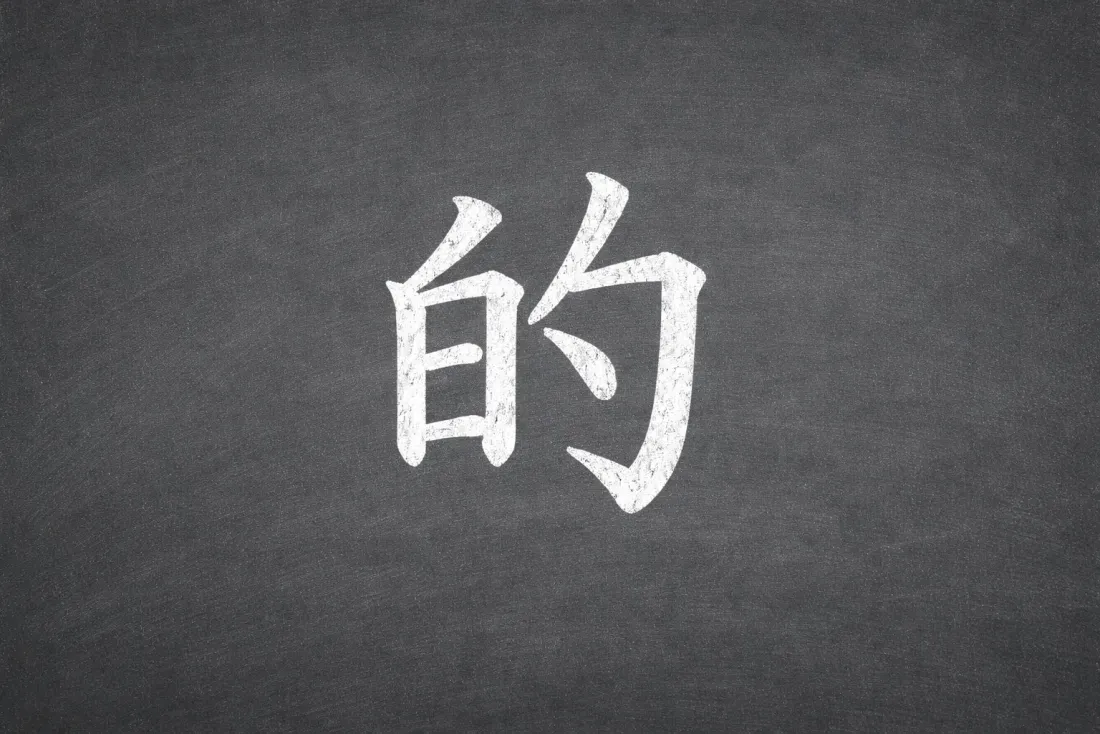
In Chinese grammar explanations, 的 is often informally referred to as 白勺的 (bái sháo de), which literally means “white spoon”. This nickname comes from the structure of the character itself: 的 is composed of 白 (white) and 勺 (spoon). The term is used for a very practical reason—there are three different de particles in Chinese (的, 得 and 地), all pronounced the same. To avoid confusion, native speakers often specify that they mean 白勺的 (bái sháo de), making it clear that they are referring to this particular 的, rather than the other two, which have different grammatical functions.
Simply put, 的 is a structural particle that most commonly serves an attributive function. It links a description, quality, or relationship to the noun that follows it. In other words, whatever comes before 的 somehow modifies or defines the noun that comes after it.
In English, this would correspond to structures such as:
- my book
- a house made of stone
- a man who lives here
In Chinese, all of these different structures are very often reduced to a single pattern:
something + 的 + noun
Example:
-
我的书 (wǒ de shū) – my book
Understanding the basic logic behind how de (的) works in Chinese is essential for forming more complex noun phrases and descriptions correctly. Although 的 is primarily an attributive structural particle, modern Chinese also includes several additional uses that are not attributive in nature. Each of these will be explained in the sections that follow.
Attributive 的: who, whose, related to what
The use of de (的) after nouns and personal pronouns
When a noun or a personal pronoun functions as an attribute expressing possession, 的 is used after it. This is the case when we want to say that something belongs to someone or is in some kind of relationship with something else. This is the most familiar use of de (的), and usually the first one learners encounter.
The basic structure looks like this:
noun or personal pronoun + 的 + noun
Examples:
- 我的手机 (wǒ de shǒujī) – my phone
- 老师的书 (lǎoshī de shū) – the teacher’s book
However, 的 is not used only to express ownership in a literal sense. It can also indicate broader relationships between two nouns.
Examples:
- 学校的右边 (xuéxiào de yòubiān) – the right side of the school
- 公司的产品 (gōngsī de chǎnpǐn) – a company’s products
In these cases, 的 does not mean “someone’s” but expresses a more general relationship, which in English might be translated as related to, belonging to, or part of.
When 的 is omitted with nominal modifiers
When a noun used as a modifier serves to explain or classify—indicating type, category, or a basic defining characteristic—the particle 的 is often omitted in Chinese.
In such cases, the first noun does not express possession, but instead more closely defines the noun that follows it.
Examples:
- 中国人 (Zhōngguó rén) – a Chinese person
- 汉语词典 (Hànyǔ cídiǎn) – a Chinese dictionary
- 学生宿舍 (xuéshēng sùshè) – a student dormitory
的 with close relationships
When nouns or personal pronouns modify nouns that refer to family members, close relationships, or members of a shared group, 的 is often omitted, especially in spoken Chinese.
Examples:
- 我妈妈 (wǒ māma) – my mum
- 我朋友 (wǒ péngyou) – my friend
Adding 的 in these cases is not grammatically incorrect (for example, 我的妈妈 wǒ de māma), but it sounds more formal, distant, or emphatic. This is why it is important to understand that the use of 的 here depends on closeness, context, and style, rather than on a rigid grammatical rule.
The use of de (的) after adjectives
Another very common use of de (的) is after adjectives or adjectival phrases functioning as attributes. In this case, 的 links a quality or description to a noun.
The basic structure is:
adjective or descriptive phrase + 的 + noun
Examples:
- 漂亮的花 (piàoliang de huā) – beautiful flowers
- 很重要的问题 (hěn zhòngyào de wèntí) – a very important question
With short, simple adjectives, especially in everyday speech, 的 is often omitted:
-
好人 (hǎo rén) – a good person
The longer or more complex the description, the more natural and frequent the use of 的 becomes.
The use of de (的) after verbs
Another important use of de (的) appears after verbs or verb phrases. In these cases, 的 introduces a description that would typically be expressed as a relative clause in English.
The structure is as follows:
verb or verb phrase + 的 + noun
Examples:
- 我买的书 (wǒ mǎi de shū) – the book that I bought
- 住在这里的人 (zhù zài zhèlǐ de rén) – the people who live here
Chinese does not have separate words for who, which, or that in relative clauses. The particle 的 takes on all of these functions.
With longer descriptions, an entire clause can appear before 的:
-
他昨天告诉我的事情 (tā zuótiān gàosu wǒ de shìqing) – the thing he told me yesterday
Omitted nouns after 的
In some cases, the noun that would normally follow 的 can be omitted entirely, as long as it is clear from the context what is being referred to, or when speaking in general terms. In such examples, the phrase ending in 的 functions like a noun, even though the noun itself is not spoken.
Example:
-
他的地图很清楚,你的怎么样?(Tā de dìtú hěn qīngchu, nǐ de zěnmeyàng?) – His map is clear. What about yours?
Here, 他的 and 你的 actually mean his map and your map, but the noun 地图 (map) is omitted because it has already been mentioned and is understood from the context.
The same applies to expressions where a verb or verb phrase appears before 的:
- 喜欢的 (xǐhuan de) – what someone likes
- 学中文的 (xué Zhōngwén de) – those who study Chinese
In these examples, 的 still links a description to a noun, but the noun remains unspoken. Depending on the context, it may refer to a thing, a person, a group of people, or a more general concept. This usage is common in written Chinese and is typical of an intermediate level of study.
Other uses of de (的)
In modern Mandarin Chinese, 的 is primarily an attributive structural particle. Its other uses appear in more limited constructions or in spoken language and do not belong to the attributive system.
The 是……的 construction
In addition to its attributive function, 的 also appears in a special sentence pattern: 是……的. In this construction, 的 does not precede a noun and does not function attributively. Instead, it is used to emphasise the circumstances of an action. This pattern is most often used when the speaker wants to highlight when, where, how, or under what circumstances something happened, assuming that the action itself is already known or taken for granted.
The basic pattern is:
subject + 是 + emphasised element + 的
Examples:
- 我是在北京学的中文。(Wǒ shì zài Běijīng xué de Zhōngwén.) – I studied Chinese in Beijing.
- 他是昨天来的。(Tā shì zuótiān lái de.) – He came yesterday.
This construction and its rules of use are discussed in more detail in a separate article dedicated specifically to 是……的 sentences.
的 at the end of a sentence (pragmatic use)
The particle 的 can also appear at the end of a sentence, where it has no attributive function and does not link a description to a noun. In this usage, 的 functions as a pragmatic or discourse particle and is most common in spoken Chinese.
Sentence-final 的 is often used to:
- emphasise or confirm information,
- soften the tone of a statement,
- express the speaker’s attitude, explanation, or a subtle emotional nuance.
This use of 的 does not change the core meaning of the sentence, but adds information about how the speaker relates to what is being said. It is particularly common in everyday speech and much less frequent in formal written language.
Examples:
- 他不去的。(Tā bú qù de.) – He’s definitely not going. / He won’t go, that’s for sure.
- 我知道的。(Wǒ zhīdào de.) – I know. / Of course I know.
In these examples, 的 does not add new grammatical meaning, but serves as a pragmatic signal through which the speaker confirms, explains, or emotionally colours their statement.
Common mistakes in the use of 的
Beginners often overuse 的, inserting it mechanically wherever English or Serbian would use a possessive ending or a relative clause. On the other hand, intermediate learners sometimes omit 的 where it is necessary, especially in more complex descriptions and verb-based modifiers.
A frequent mistake is also omitting 的 indiscriminately when two nouns appear next to each other, without understanding whether the first noun indicates a category or a specific relationship. This is precisely why it is not enough to memorise rules such as “的 goes here” or “的 does not go here”. What matters is understanding what modifies what in a sentence, and what kind of relationship the speaker wants to express.
Conclusion
If there is one key thing to remember about the particle 的, it is this: 的 links an attribute to a noun. Whether it expresses possession, a quality, an action, or an abstract concept, its core function remains the same. When viewed as a whole, the use of de (的) in Chinese is not based on memorising isolated rules, but on understanding the relationship between a description and the noun it modifies.
Once we start to see 的 as a structural particle rather than as a word without a translation, it becomes a much clearer and more natural part of the Chinese language.
For more articles like this on the use of de (的) in Chinese, follow the blog, where I share tips, examples, and clear explanations of Chinese grammar.