


The start of a new school year is the perfect time to refresh your knowledge and pick up something new.
Whether you’re just beginning your Chinese learning journey or have been studying for a while, the school environment is full of practical vocabulary you can easily connect to everyday situations.
In this post, you’ll find a handy Chinese school-themed vocabulary list, organized by categories – from subjects and classroom supplies to school facilities and people you’ll meet on campus.
And that’s not all: at the end, you can download a free set of flashcards to practice at home, plus take a short quiz to test what you’ve learned!
Basic School Terms in Chinese
Before we move on to subjects and school staff, it’s important to learn a few basic terms that students commonly use in their daily school life.
| Word | Pinyin | Meaning |
|---|---|---|
| 学校 | xuéxiào | School |
| 课 | kè | Class / Subject |
| 作业 | zuòyè | Homework |
| 考试 | kǎoshì | Test / Exam |
| 上课 | shàng kè | To attend class / Have class |
| 下课 | xià kè | End of class |
| 成绩 | chéngjì | Grade / Results |
| 学期 | xuéqī | Term / Semester |
| 寒假 | hánjià | Winter Break |
| 暑假 | shǔjià | Summer Break |
School Subjects
School subjects are a great starting point when learning Chinese, since they’re part of every student’s daily routine. As you build your Chinese school vocabulary, these words will help you talk about what you study and make connections to real-life classroom situations.
Below is a list of the most common school subjects in Chinese.
| Subject | Pinyin | Meaning |
|---|---|---|
| 数学 | shùxué | Mathematics |
| 汉语 | hànyǔ | Chinese language |
| 中文 | zhōngwén | Chinese language |
| 英语 | yīngyǔ | English language |
| 历史 | lìshǐ | History |
| 地理 | dìlǐ | Geography |
| 生物 | shēngwù | Biology |
| 化学 | huàxué | Chemistry |
| 物理 | wùlǐ | Physics |
| 美术 | měishù | Art |
| 音乐 | yīnyuè | Music |
| 体育 | tǐyù | Physical education (PE) |
To refer to a subject’s class, you can add the word 课 (kè) after the subject name. For example:
– 数学 (shùxué) → 数学课 (shùxué kè) – math class
– 语文 (yǔwén) → 语文课 (yǔwén kè) – Chinese language class
– 音乐 (yīnyuè) → 音乐课 (yīnyuè kè) – music class This way, you can easily form the names of all school classes using the word 课 (kè).
Hànyǔ vs Zhōngwén – What’s the Difference?
When learning Chinese, you may come across two terms: Hànyǔ (汉语) and Zhōngwén (中文).
Hànyǔ (汉语) literally means “the language of the Han people” and is used when referring to the language as a system — grammar, vocabulary, and pronunciation.
Zhōngwén (中文) means “Chinese language/writing” and is more commonly used in everyday speech, especially when talking about Chinese as a school subject or when referring to reading and writing.
In short: both mean Chinese, but Hànyǔ emphasizes the language and its linguistic aspects, while Zhōngwén emphasizes culture and the written form of the language.
Example Sentences 例如 (lì rú):
- 我最喜欢数学课。
Wǒ zuì xǐhuān shùxué kè.
→ My favorite class is Math. - 今天有中文课。
Jīntiān yǒu Zhōngwén kè.
→ Today we have Chinese class.
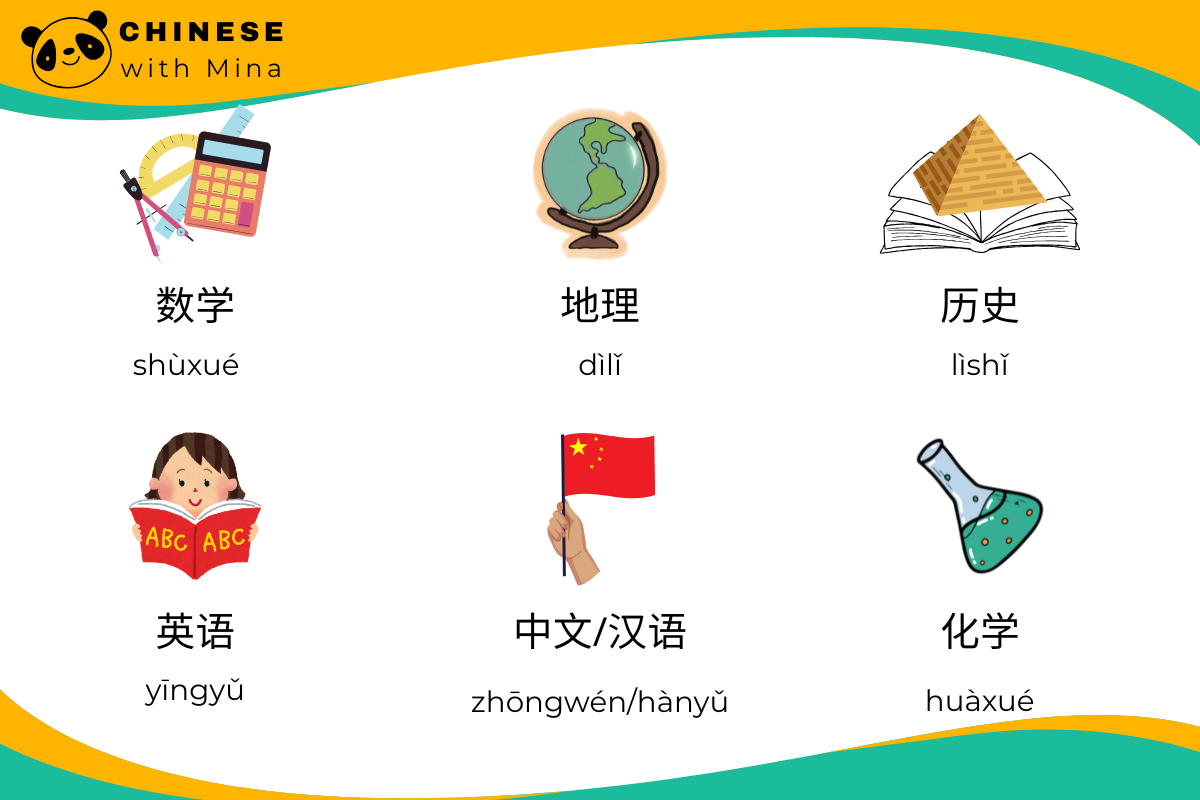
School Supplies
School supplies are the essentials that make every school day run smoothly. These everyday items are easy to recognize and remember, making them perfect for anyone learning Chinese as part of their Chinese School Vocabulary, as they connect words to the objects they see and use in the classroom.
| Item | Pinyin | Meaning |
|---|---|---|
| 本子 | běnzi | Notebook |
| 书 | shū | Book |
| 铅笔 | qiānbǐ | Pencil |
| 钢笔 | gāngbǐ | Pen |
| 橡皮 | xiàngpí | Eraser |
| 尺子 | chǐzi | Ruler |
| 铅笔盒 | qiānbǐhé | Pencil case |
| 书包 | shūbāo | Backpack |
| 剪刀 | jiǎndāo | Scissors |
| 课本 | kèběn | Textbook |
| 彩色笔 | cǎisè bǐ | Colored pencils / markers |
Example Sentences 例如 (lì rú)
- 我的书包很重。
Wǒ de shūbāo hěn zhòng.
→ My backpack is heavy. - 桌子上有一本书。
Zhuōzi shàng yǒu yī běn shū.
→ There is a book on the table.
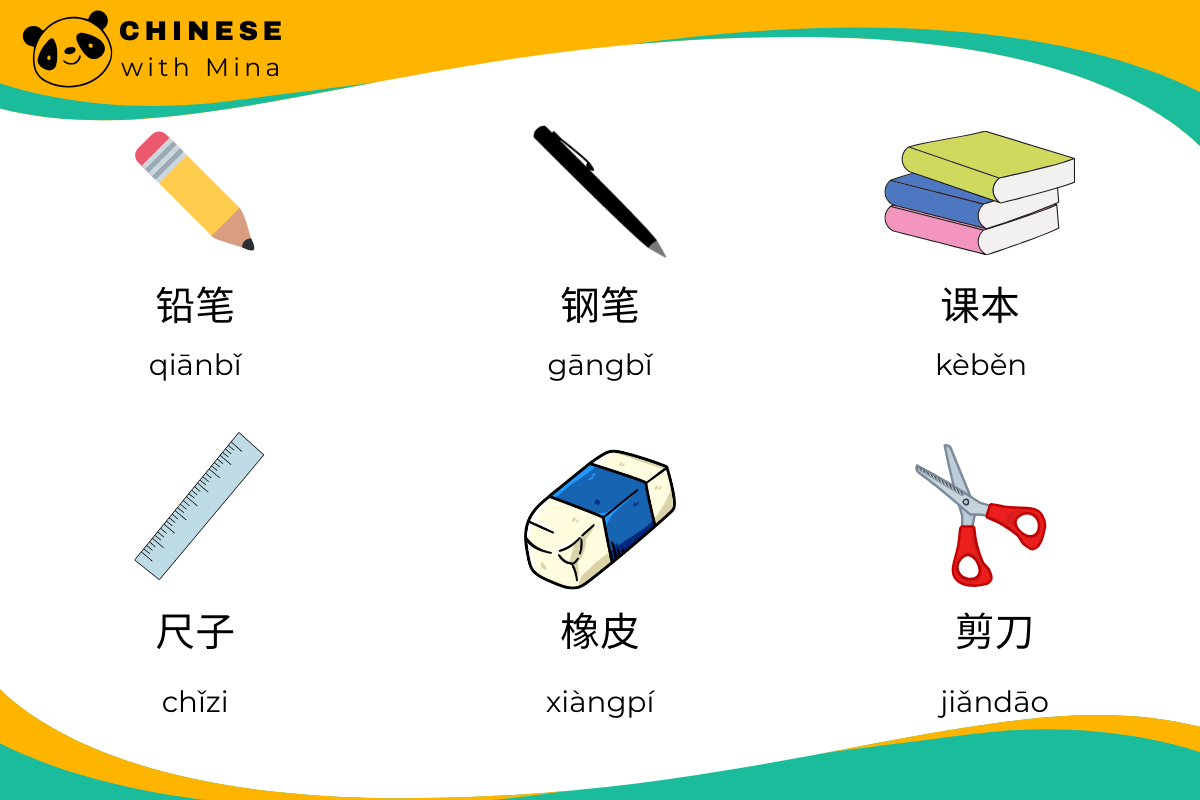
School facilities
Schools are full of different rooms where students spend their time – from classrooms and libraries to gyms and sports halls.
| Room | Pinyin | Meaning |
|---|---|---|
| 教室 | jiàoshì | Classroom |
| 图书馆 | túshūguǎn | Library |
| 实验室 | shíyànshì | Laboratory |
| 食堂 | shítáng | Canteen |
| 操场 | cāochǎng | Playground / Yard |
| 体育馆 | tǐyùguǎn | Gym / Sports Hall |
| 办公室 | bàngōngshì | Office |
| 校长办公室 | xiàozhǎng bàngōngshì | Principal’s Office |
Example Sentences 例如 (lì rú)
- 图书馆里有很多书。
Túshūguǎn lǐ yǒu hěn duō shū.
→ There are lots of books in the library. - 我们去操场踢足球吧。
Wǒmen qù cāochǎng tī zúqiú ba.
→ Let’s go to the playground to play soccer.
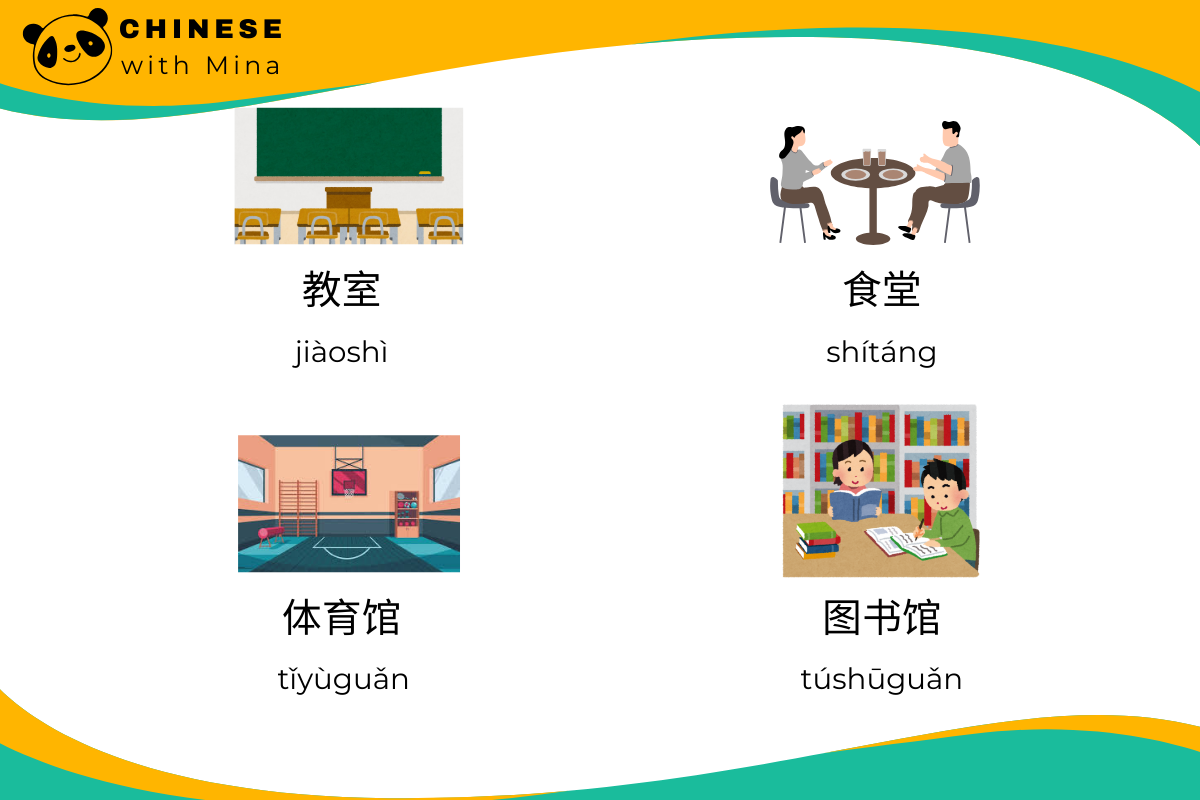
School Personnel
Besides students, schools have teachers, professors, and other staff members. Here are the essential terms that will come in handy as part of your Chinese School Vocabulary.
| Person | Pinyin | Meaning |
|---|---|---|
| 学生 | xuéshēng | Student |
| 老师 | lǎoshī | Teacher / Professor |
| 同学 | tóngxué | Classmate |
| 校长 | xiàozhǎng | Principal |
| 班主任 | bānzhǔrèn | Homeroom Teacher |
| 教练 | jiàoliàn | Coach |
| 图书管理员 | túshū guǎnlǐyuán | Librarian |
Example Sentences 例如 (lì rú)
- 学生们在教室里听课。
Xuéshēng men zài jiàoshì lǐ tīng kè.
→ Students are attending class in the classroom. - 校长在办公室工作。
Xiàozhǎng zài bàngōngshì gōngzuò.
→ The principal is working in the office.
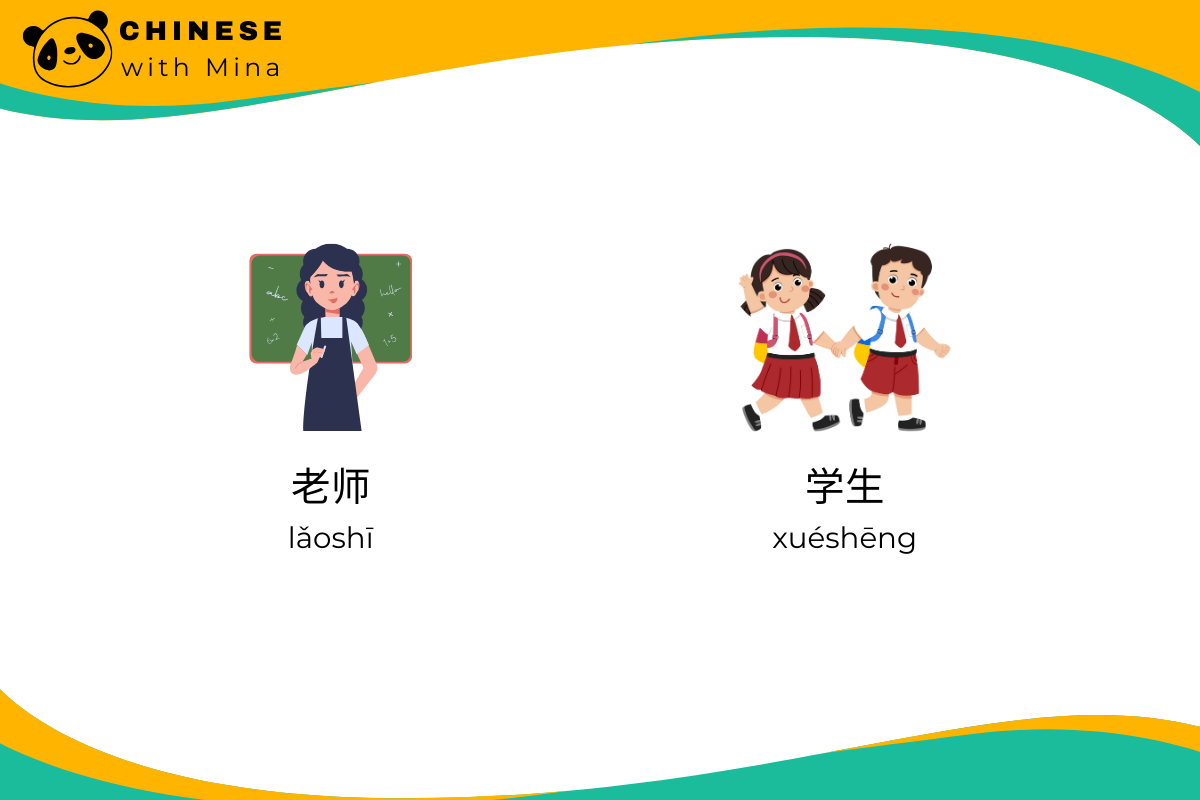
Flashcards
To make learning Chinese fun and practical, I’ve prepared free flashcards to help you master your Chinese School Vocabulary. Each card shows:
- An image of the item to help you visually remember the word,
- The Chinese character for recognizing the written language,
- Pinyin so you know how to pronounce it,
- The English translation to instantly connect the meaning.
You can use the flashcards in multiple ways: for quick home lessons, reviewing before bed, or turning learning into games. If you print them out, you can also use them as traditional paper flashcards.
Download your flashcars set here!

Test Your Knowledge
See how much you’ve learned with a mini quiz! Click Start and test your Chinese School Vocabulary skills.
💡 Challenge yourself and see how many words you can remember!
#1. Which Chinese word means “Notebook”?
#2. What is the Chinese word for “Library”?
#3. How do you say “Backpack” in Chinese?
#4. Which Chinese word means “Teacher / Professor”?
#5. What is the Chinese word for “Playground / Yard”?
#6. How do you say “Principal” in Chinese?
Results
Enjoyed this post and the flashcards? Follow the blog for more fun and educational content, and discover new ways to expand your Chinese School Vocabulary!