The Legend of the Great Race and the 12 Animals of the Chinese Zodiac
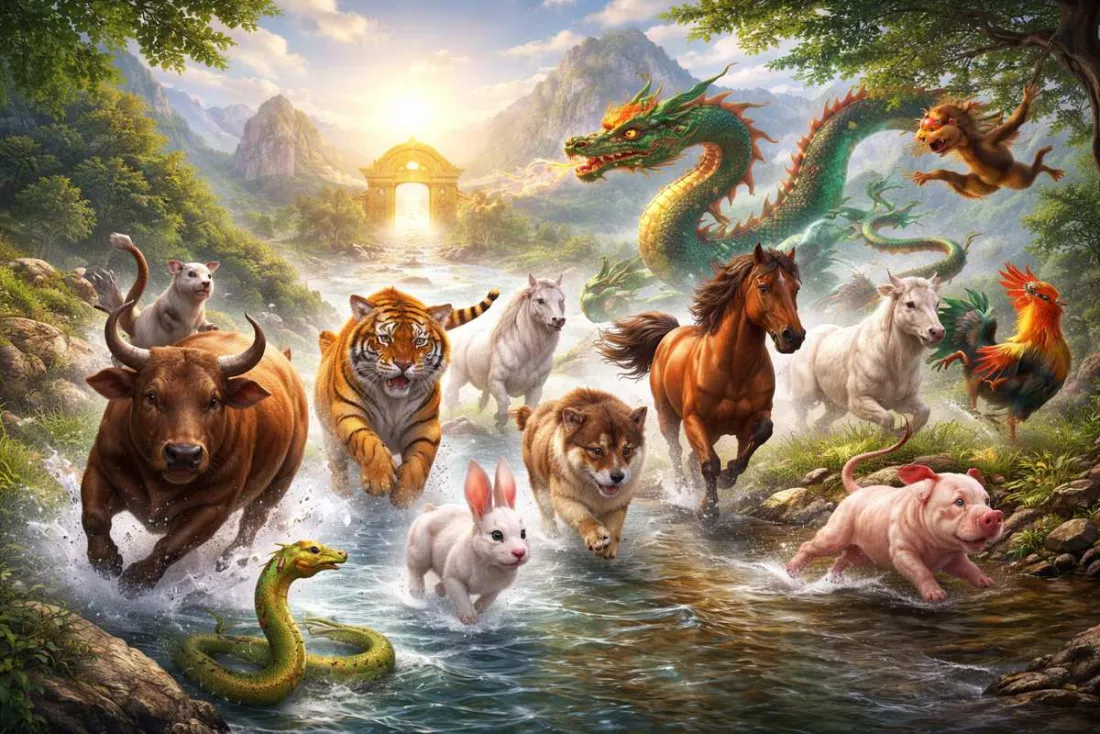
This year, Chinese New Year begins on 17 February, marking the start of the Year of the Horse according to the Chinese calendar. Each new year is associated with one of the twelve animals of the Chinese zodiac, but their order does not occur at random; it originates from the legend of the Great Race.
In Chinese tradition, legends are not just fairy tales for children. They convey values, patterns of behaviour and ways of thinking, so the characteristics of the zodiac animals are often interpreted in relation to their roles in this story.
The Legend of the Great Race
According to legend, the Jade Emperor (玉帝, Yù Di), the divine ruler of Heaven, wanted to organise the measurement of time. He decided that the years in the calendar would be marked by animals, and that their order would be determined by a simple yet fair competition.
He invited all the animals and announced that the first twelve to cross the river would earn their place in the calendar in the order they reached the finish line. The river, which was not easily overcome, symbolised the need for challenge, resourcefulness and perseverance.
On the day of the race, each animal relied on its strengths: strength, speed, cunning, or patience. For this reason, it is believed that the order in which they arrived reflects their character traits.
The Order of the Chinese Zodiac Animals
The Rat: resourcefulness
Despite being the smallest participant, the Rat displayed remarkable intelligence. Realising that he could not swim across the river alone, he asked the Ox to carry him on its back. When they reached the opposite bank, the Rat jumped off at the last moment and crossed the finish line first. This is why the Rat is associated with intelligence, quick thinking and the ability to seize opportunities.
The Ox: strength, patience, and reliability
The Ox remained calm and persistent throughout the race. He carried the Rat across the river without complaint and almost finished first. His second-place finish symbolises values that are highly prized in Chinese culture: diligence, reliability, and stability, even when someone else gets the credit.
The Tiger: courage and competitiveness
The Tiger symbolises courage and competitiveness. He swam strongly and battled the river’s strong current. Although he was one of the strongest competitors, the obstacles slowed him down. His place in the zodiac is associated with courage, ambition, natural authority and fighting against the odds.
The Rabbit: speed and caution
The Rabbit is associated with speed and caution. It leapt over rocks and floated over obstacles. In some versions of the legend, he escaped by clinging to a floating log. His arrival symbolises caution, elegance and the ability to survive through resourcefulness rather than strength.
The Dragon: power to help others
The dragon had the power to win easily, but he chose to help others instead. He brought rain to a drought-stricken village and helped the rabbit cross a river. Because of this, he did not arrive first. In Chinese tradition, the dragon symbolises power, as well as nobility and responsibility.
The Snake: silence and strategy
The Snake reached the finish line almost imperceptibly, hiding in the Horse’s mane. When he emerged, Snake surprised the Horse and took the lead. It is associated with wisdom, intuition, and strategic thinking.
The Horse: energy and freedom
The horse symbolises energy and freedom. It was crossing the river with strength and speed, but the snake’s sudden appearance startled and slowed it down. Nevertheless, the horse remains a symbol of movement, freedom, vitality and the need to move forward unhindered.
Read more about the symbolism and meaning of the Year of the Horse in a separate article:
👉 The Year of the Horse in the Chinese zodiac
The Goat: gentleness and cooperation
The Goat is a symbol of gentleness and cooperation. It crossed the river with the help of other animals, and legends often mention its partnership with the monkey and the rooster. In some versions of the story, the goat, monkey and rooster built a raft and sailed to the finish line together. The goat’s place in the horoscope is associated with gentleness, empathy, and a need for harmony.
The Monkey: ingenuity and adaptability
The Monkey is associated with ingenuity and adaptability. It used its intelligence and dexterity to overcome obstacles. Its role in the race is reflected in the symbolism of curiosity, creativity and adaptability.
The Rooster: order and organisation
Although the rooster was not a strong swimmer, he helped others by planning and finding solutions. For this reason, he is associated with precision, responsibility, and a sense of order, even in chaotic circumstances.
The Dog: loyalty and fairness
The Dog is associated with loyalty and fairness. Although an excellent swimmer, he stopped to play in the water during the race. It arrived at the finish line later, but its symbolism remains strong: faithfulness, honesty, and a protective instinct.
The Pig: enjoyment and sincerity
The Pig came last because it stopped to eat and rest along the way. In Chinese culture, however, this is not viewed negatively. The pig symbolises sincerity, contentment, and the ability to enjoy life.
The connection between the Great Race and the Chinese calendar
The order of the animals in the Great Race forms the basis of the Chinese zodiac’s twelve-year cycle. Each year is associated with an animal, and the cycle repeats throughout the Chinese lunar calendar. However, the meaning of a year depends not only on the animal, but also on the elements and the yin-yang principle. This is why the perception of the same animal can vary.
This is precisely why the legend of the Great Race is not just a story about the origin of the horoscope, but also a key to understanding how the Chinese view time, cycles and human nature.
Why the legend of the Great Race is important today
Although it originates from ancient times, the legend of the Great Race is still passed down, retold and interpreted today. It encourages viewing the Chinese zodiac as a cultural and symbolic system rather than as mere fortune-telling. Each animal carries its own story, character and energy, and together they form a cycle that constantly renews itself.
If you enjoy articles like these about Chinese culture, language, and tradition, follow the blog!