
Chinese Pinyin Explained: A Simple Guide to Chinese Pronunciation
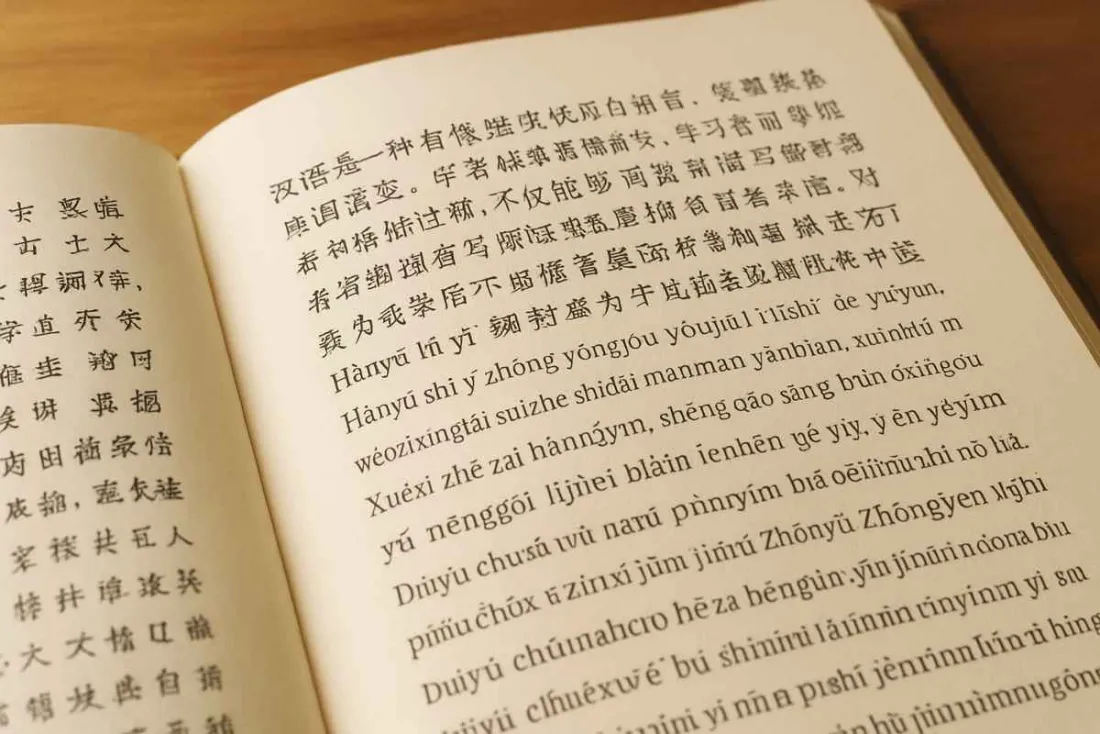
Although Chinese uses a writing system completely different from European languages, its pronunciation can still be written using the Latin alphabet. The system used for this is called pinyin (拼音, pīnyīn), and it’s the very first step every learner of Chinese needs to master.
Chinese Pinyin links characters to their pronunciation, allowing us to hear and produce a word even before we learn to recognise the character itself.
What is Chinese Pinyin?
The word pinyin literally means “spelling out sounds”, which is exactly what it does. It links the sounds of the Chinese language into syllables that we can read and pronounce. Chinese pinyin was developed in the 1950s as the official system for transcribing Mandarin phonetically, and today it’s used everywhere: in schools, textbooks, and dictionaries.
It’s essential for anyone learning Chinese as a foreign language, but it’s also used by Chinese children when they first begin to read. And whenever people type on a computer or a phone, they use pinyin to input text and then select the character they want to write.

Pinyin does not translate Chinese characters, it only shows how characters are pronounced.
For example:
你 → nǐ (you)
好 → hǎo (good)
你好 → nǐ hǎo (hello)
What is Chinese pinyin made up of?
Every Chinese word is composed of one or more syllables. Each syllable follows the same structure:
initial + final (+ tone)
For example:
-
m + a → ma
-
h + ao → hao
-
zh + ong → zhong
Modern Mandarin contains around 400 basic syllables formed by combining initials and finals. When tones are included, this number rises to roughly 1,300 distinct sound combinations. Tones are a crucial part of pronunciation, but in this article we’ll focus on the first two elements — initials and finals — as they form the core of the Chinese pinyin sound system.
Initials (声母, shēngmǔ)
An initial is the sound that begins the syllable, usually a consonant. Mandarin has 21 standard initials:
- b, p, m, f, d, t, n, l, g, k, h, j, q, x, z, c, s, zh, ch, sh, r, (y, w)
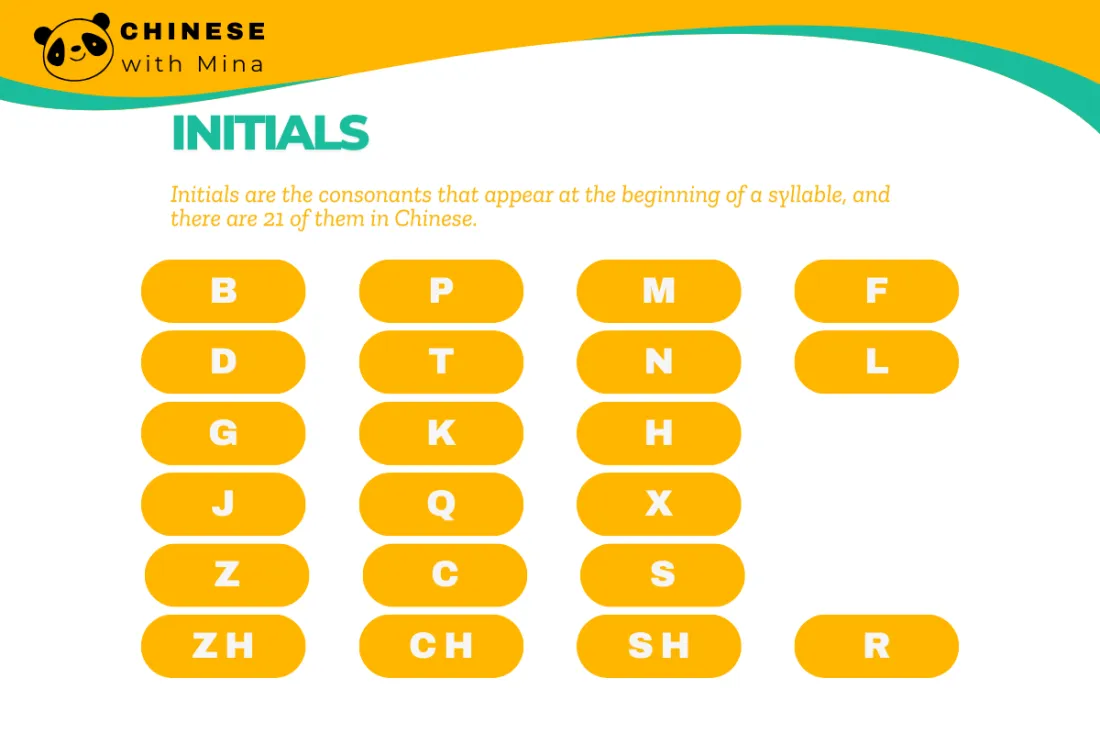
Some initials resemble sounds found in many languages (such as b, p, m, f, d, t, n, l, g, k, h), while others have pronunciation features unique to Mandarin.
Here are a few key notes:
1. j, q, x are palatal sounds — produced with the tongue raised toward the hard palate:
-
j — similar to the j in jeep, but with the tongue slightly further forward
-
q — similar to ch in cheese, but softer and more fronted
-
x — a soft “sh”-like sound, somewhere between sh and the hy in hue
2. zh, ch, sh are retroflex sounds — the tongue curls slightly backward:
-
zh — similar to j in judge, but with a stronger retroflex quality
-
ch — similar to ch in chair, but more strongly aspirated
-
sh — similar to sh in shoe, but produced with the tongue curled back
3. The Mandarin r is a unique sound — somewhere between the English r and the zh in measure, as in rén 人 (“person”).
The zero initial
When a syllable does not begin with a true initial consonant, we say it has a zero initial. In these cases, the syllable phonetically starts with a vowel sound (i, u, ü), but Chinese pinyin modifies the spelling to make the word easier to read and write.
To avoid syllables beginning directly with a vowel sound, y or w is added, or the initial vowel is replaced by these letters:
- i → y
ia → ya, ie → ye, iong → yong
- u → w
ua → wa, uo → wo, uang → wang
- ü → yu
ü → yu, üe → yue, üan → yuan
This is why words such as yī (一, one) or wǒ (我, I) look as if they begin with an initial consonant, even though the syllable actually starts with a vowel sound.
It’s important to emphasise:
y and w may appear to function as initials here, but they are not true initials. They simply mark the beginning of the syllable in writing to make it clearer and more readable.
This rule often confuses beginners, because it can create the impression that Mandarin has more initials than it really does. In practice, it’s just a spelling convention — the actual sound structure of the syllable stays the same.
Finals (韵母 yùnmǔ)
A final is the ending part of a syllable, consisting of a vowel or a combination of vowels, sometimes followed by a nasal ending (n or ng). Mandarin has 36 finals, grouped into three categories:
- Simple finals: a, o, e, i, u, ü
- Compound finals: ai, ei, ao, ou, ia, ie, ua, uo, iao, iou, uai, uei, üe
- Nasal finals: an, en, in, un, ün, ian, uan, üan, ang, eng, ong, ing, iang, iong, uang, ueng


A few notes:
- The vowel ü is pronounced similarly to the German ü. The lips are rounded as for u, while the tongue is positioned as for i. When it appears after j, q, x, it is written as u, even though the sound is still ü (e.g. ju → jü, qu → qü, xu → xü). This often confuses learners because the spelling changes, but the pronunciation does not.
- The final er (儿) has a distinct pronunciation, with a light “r” sound that often merges with the preceding syllable.
Tones in Mandarin Chinese
Mandarin is a tonal language, which means that changing the pitch of your voice can completely alter the meaning of a word—even if the spelling in Chinese pinyin stays the same. Standard Mandarin has four main tones, plus a neutral tone.
- First tone – high and steady
mā 妈 – “mother” - Second tone – rising, similar to the intonation we use when asking a question
má 麻 – “hemp” - Third tone – falling then rising
mǎ 马 – “horse” - Fourth tone – sharp and falling
mà 骂 – “to scold; to tell someone off” - Neutral tone – light and unstressed, written without any tone mark
ma 吗 – a question particle
Tones are an essential part of Mandarin pronunciation. Using the wrong tone can completely change the meaning of a word. Although they may seem challenging at first, with listening practice, repetition, and a bit of patience, they quickly become a natural part of speaking.
We’ll explore tone rules, tone sandhi, and practical ways to practise correct pronunciation in a separate article.
Why mastering Chinese Pinyin matters
Without a solid grasp of Chinese Pinyin, it’s difficult to make real progress in Mandarin. Pinyin helps you to:
- read and pronounce every new word correctly,
- learn Chinese characters more easily,
- understand the phonetic logic of the language — how sounds fit together, and why.
Once you understand how initials and finals work, Mandarin stops feeling overwhelming. Each syllable follows a clear structure, and what once seemed like a stream of unfamiliar sounds becomes a system that actually makes sense.
A quick tip for learners:
If you’d like a concise visual overview of all initials and finals, you can download a free Chinese pinyin PDF guide from the Downloads page.
Conclusion
Chinese pinyin forms the foundation of Mandarin phonetics and is the first real step towards accurate pronunciation. It links sound, meaning and character, allowing learners to speak clearly and confidently from the very beginning. Later, as tones and Chinese characters are added on top of this foundation, the language becomes far more intuitive and logical than it may initially seem.
For more inspiration and extra learning materials, feel free to explore the blog.