


If you’re learning Chinese, you probably already know that there are two ways to say the number two: 二 (èr) and 两 (liǎng). Even though both words mean “two” in English, in Chinese it definitely matters which one you use. Using the wrong form isn’t correct and can sound odd to native speakers. Deciding which version of “two” to use in a given situation is often not so easy.
So, if you’d like to learn what 二 (èr) and 两 (liǎng) actually mean, how to use them properly, and test your knowledge with a quiz at the end—keep reading!
When to Use 二 (èr)
The character 二 (èr) is used whenever “two” appears as an independent digit or as part of a number, without referring to a specific quantity of things. In other words, 二 (èr) is used in counting, ordinal numbers, dates, phone numbers, addresses, license plates—anywhere you’re simply reading or saying the digit “2”.
For example, when counting:
一 (yī), 二 (èr), 三 (sān) — one, two, three.
Likewise:
- 12 is 十二 (shí èr)
- 20 is 二十 (èr shí)
- 200 is 二百 (èr bǎi)
二 (èr) is also used for ordinal numbers. To say “second”, you add the word 第 (dì) in front of the number two: 第二 (dì èr).
Examples:
- 第二天 (dì èr tiān) – the second day
- 第二名 (dì èr míng) – second place
You must also use 二 (èr) in things like numbering and identification codes, where you pronounce the digit itself. For example:
- 二号楼 (èr hào lóu) – building number 2
- Phone numbers: in 152-8322-2722, each digit is read one by one
- Dates: 二月二号 (èr yuè èr hào) – February 2nd
When to Use 两 (liǎng)
The character 两 (liǎng) is almost always used in modern Chinese when expressing a quantity or number of things. Whenever “two” refers to a number of objects, people, or units, 两 (liǎng) is used instead of 二 (èr).
两 (liǎng) can be translated as two of something or both. It most often appears in front of a measure word (量词), which indicates the type or unit of the item being counted. For example:
-
两个人 (liǎng gè rén) – two people
-
两本书 (liǎng běn shū) – two books
-
两杯茶 (liǎng bēi chá) – two cups of tea
-
两块钱 (liǎng kuài qián) – two yuan
It’s also used when talking about amounts of time:
-
两点 (liǎng diǎn) – two o’clock
-
两分钟 (liǎng fēn zhōng) – two minutes
Let’s sum up:
二 (èr) is the digit 2 and is used when simply pronouncing the number as a numeral. But when talking about a quantity of something, you use 两 (liǎng) instead. That’s why we don’t say 二个人 (èr gè rén) – two people – but rather 两个人 (liǎng gè rén).
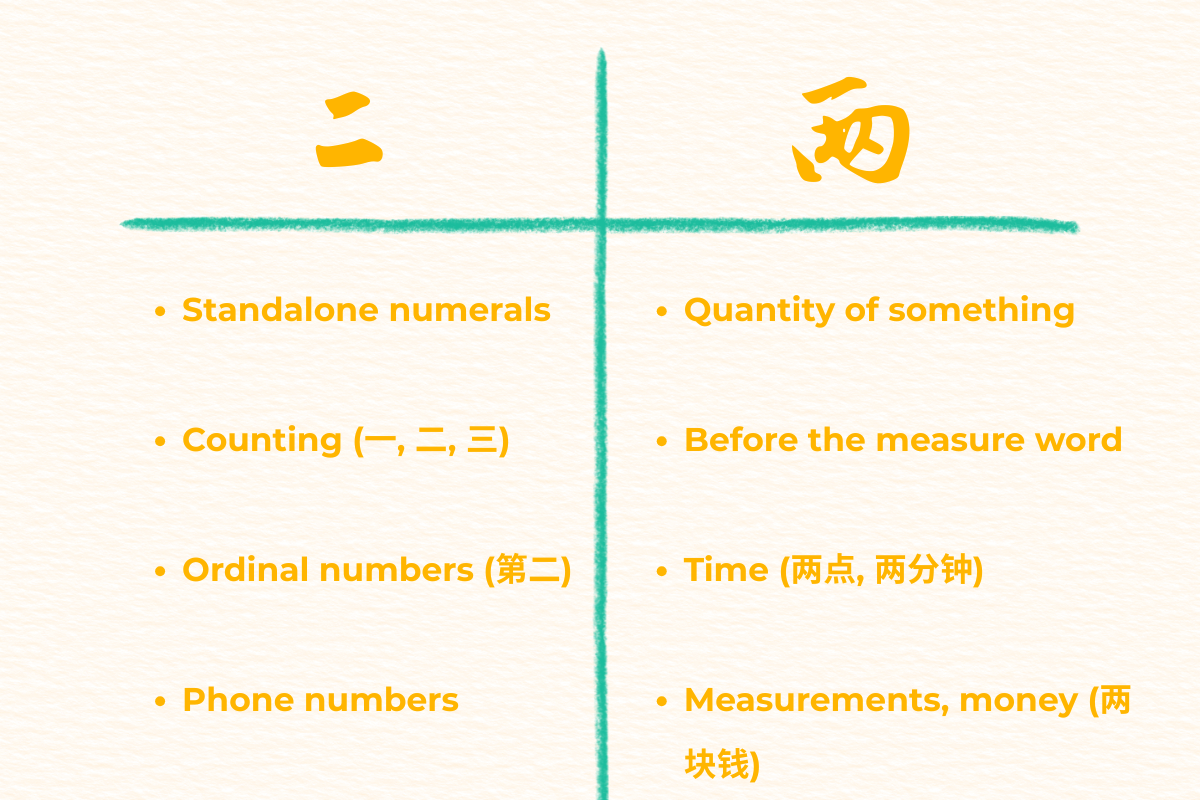
Take a look at the table for a quick overview:
Final word
I hope this text helped you finally understand when to use 二 (èr) and when to use 两 (liǎng)! 😊
If you enjoy content like this, follow my Instagram page, where I share more useful tips and interesting facts about the Chinese language, literature, and culture. There are more similar posts waiting for you on the blog — feel free to explore!
Quiz
Now test your knowledge! I’ve prepared a mini quiz so you can see how well you distinguish 二 (èr) and 两 (liǎng)! 👇