


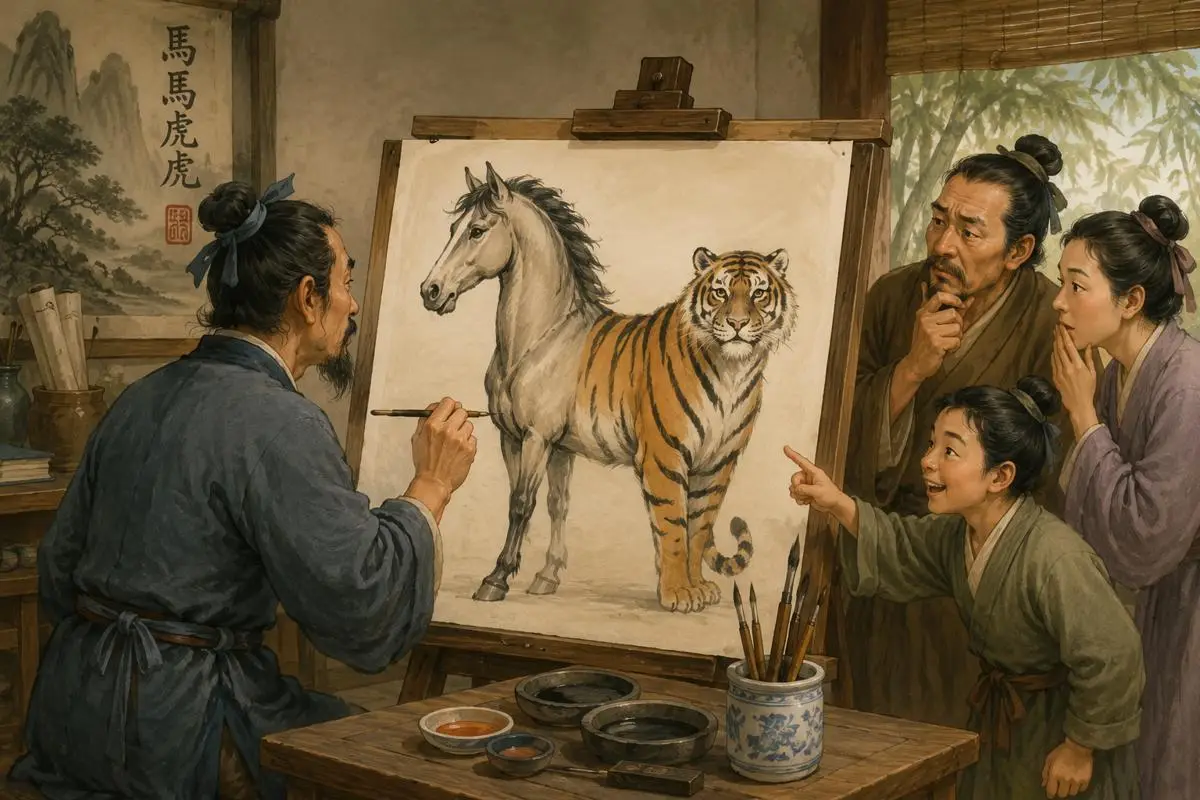
When you start learning Chinese, you quickly realise that some words and phrases do not translate neatly into English. One of the best examples is 马马虎虎 (mǎmǎhūhū). At first, it sounds funny and easy to remember, but behind these four characters is a surprisingly interesting story and a way of thinking that says a lot about Chinese language and culture.
Chinese people use this phrase all the time — with friends, at work, when meeting new people, or even when talking about their own skills. If you study Chinese or watch Chinese dramas online, you have probably heard it already. Depending on the context, it can mean “so-so”, “not bad”, “average”, or even “careless” and “sloppy”.
What makes 马马虎虎 especially interesting is that it is more than just vocabulary. Like many Chinese expressions, it comes with a memorable story and cultural background, which is one of the reasons learners tend to remember it very quickly.
What does 马马虎虎 (mǎmǎhūhū) mean and how is it used?
The phrase 马马虎虎 is pronounced mǎmǎhūhū. The character 马 (mǎ) means “horse”, while 虎 (hǔ) means “tiger”, so the expression literally sounds like “horse-horse-tiger-tiger”. Strange as it may sound, that slightly unclear image is actually connected to the meaning of the phrase itself.
Depending on the context, 马马虎虎 is usually translated as:
- so-so
- not bad
- average
- careless
- sloppy
If someone asks how good your Chinese is, one of the most common replies you will hear is simply:
- 马马虎虎 (mǎmǎhūhū)
In this situation, the phrase is not negative at all. It usually sounds modest and friendly instead. In Chinese culture, people generally avoid praising themselves too directly, so even someone who speaks excellent Chinese might still answer with 马马虎虎 just to sound more humble.
At the same time, the expression can also have a more critical meaning. For example, if someone says:
- 他工作马马虎虎。(Tā gōngzuò mǎmǎhūhū.)
it means the person works carelessly or does not pay much attention to detail.
That is exactly what makes 马马虎虎 so interesting for Chinese learners. The same phrase can sound polite and modest in one conversation, but slightly critical in another, depending entirely on the context.
Why is 马马虎虎 (mǎmǎhūhū) used so often?
One of the reasons this expression has survived for so long is its flexibility. It can describe the quality of something, a person’s effort, the way someone works, or even a general mood or situation.
Chinese speakers also use it out of politeness. Instead of directly saying they are very good at something, many people prefer to give a more modest answer. Because of that, 马马虎虎 (mǎmǎhūhū) often sounds more natural and culturally appropriate than an overly confident reply.
Another reason the phrase is so memorable is its rhythm. Repetition like this is very common in Chinese, and the catchy sound of 马马虎虎 is exactly why so many foreigners remember it after hearing it only a few times.
The story behind 马马虎虎 (mǎmǎhūhū)
Like many Chinese expressions, 马马虎虎 (mǎmǎhūhū) comes with a story that has been passed down for generations.
According to a traditional folk legend, there was once a talented painter who was well known for his artistic skill, but also for being careless and impatient. He often rushed his work, started several paintings at the same time, left pieces unfinished, and paid very little attention to detail.
One day, he began painting a tiger. Halfway through, however, he lost interest and abandoned the painting before finishing it. The head looked like a tiger, while the rest of the body resembled a horse. When someone asked what he was actually painting, the artist casually replied: “Maybe a horse, maybe a tiger.”
Later, members of his family misunderstood the painting precisely because it was so unclear. His eldest son saw the picture and believed it showed a tiger. According to the legend, he later tried to hunt a tiger but ended up chasing an ordinary horse instead.
The younger son made the opposite mistake. He believed the painting showed a horse, so when he later came across a real tiger, he was not frightened by it.
The painter eventually realised how much trouble carelessness and lack of precision could cause. He burned the painting and began warning people not to do things 马马虎虎. Over time, the story became a well-known example of sloppiness and inattention.
That is how the expression 马马虎虎 came to describe something done carelessly, imprecisely, or in a rather “so-so” way. Interestingly, in modern Chinese the phrase is also often used in a softer sense, simply meaning average, decent, or nothing special.
This expression is a great example of how vivid and visual the Chinese language can be. Behind just four characters is a memorable little story, which is exactly why learners tend to remember the phrase so easily.
Conclusion
Chinese is full of expressions that seem simple at first glance but actually carry interesting stories and ways of thinking that reflect Chinese culture. 马马虎虎 (mǎmǎhūhū) is a perfect example of that. It is short, memorable, and used in everyday conversation, which is why Chinese learners usually pick it up very quickly.
Besides being useful in daily speech, the phrase also shows just how important context and nuance are in Chinese. In one situation it can sound modest and friendly, while in another it may describe someone as careless or inattentive.
That is exactly why 马马虎虎 is more than just another vocabulary phrase. It also offers a small glimpse into the way people communicate in everyday Chinese life.
If you enjoyed this article and would like to learn more interesting expressions, Chinese characters, and stories from Chinese culture, follow Kineski sa Minom on Instagram and keep exploring the blog ✨