


The Mid-Autumn Festival isn’t just a time for family gatherings and enjoying mooncakes – it’s also a moment to reflect on the ancient legends that have accompanied the full moon for centuries. The most famous of these is the story of Chang’e, the Moon Goddess, but there are plenty of other enchanting tales that make this festival even more magical.
Chang’e and Hou Yi
According to legend, long ago there were ten suns in the sky. Their unbearable heat scorched the land, dried up rivers, and destroyed crops. People suffered terribly, until a hero named Hou Yi, a fearless archer, appeared. He climbed the highest mountain, drew his mighty bow, and shot down nine of the suns, leaving just one to provide warmth and life.
(More about him can be read here.)
The Goddess of the West, moved by his courage, gifted him the elixir of immortality. Hou Yi kept it safe at home, because eternity meant nothing to him without his wife, Chang’e. He wanted to share it with her so they could be together forever.
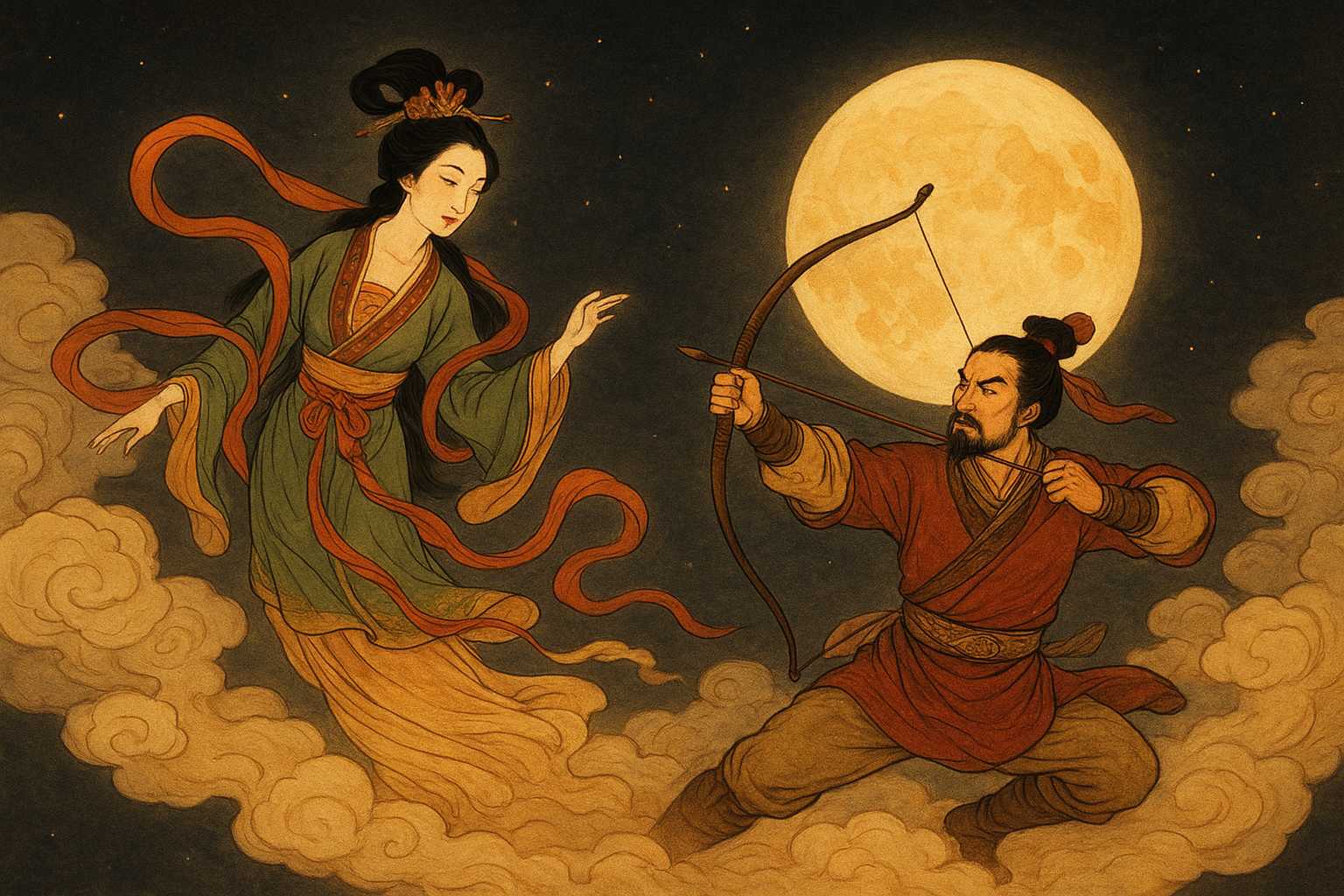
This is where the story branches into different versions. In one, while Hou Yi was away hunting, his apprentice tried to steal the elixir. Seeing no other choice, Chang’e drank it to keep it from getting in the wrong hands. Instantly, she became as light as a feather and floated up to the heavens. When Hou Yi returned, he could only watch as she rose, and as she turned one last time, her gaze was full of sorrow and love.
In another version, Chang’e drank the elixir out of curiosity, unaware that it would separate her from her beloved forever. Some tales even portray her as selfish, with her punishment being eternal loneliness.
In every version, the ending is the same. Chang’e ascended to the Moon and became the goddess that people still imagine when gazing at the full moon. Hou Yi remained on Earth, broken and alone. Each night, he would offer fruit and cakes, praying to the Moon, hoping to catch a glimpse of his wife. People followed his example, and thus began the tradition of presenting offerings to the Moon during the Mid-Autumn Festival. This tradition has become a symbol of love, remembrance, and everlasting longing.
Chang’e and the Moon Rabbit
Chang’e was not alone on the Moon. By her side was her faithful companion, the Moon Rabbit, also known as the Jade Rabbit. According to legend, he tirelessly pounds magical herbs in his mortar, preparing the elixir of immortality for the gods and for Chang’e. His presence represents loyalty and endless dedication, and every movement of his conveys peace and harmony.
While in the West we often imagine a human face on the surface of the Moon, in Chinese tradition people have long recognised the outline of a rabbit sitting and working. The rabbit is more than just Chang’e’s companion – it is also a symbol of immortality, patience, and quiet devotion. That’s why in Chinese art, poetry, and festivals, the Moon Rabbit almost always appears alongside Chang’e.
During festivals, children make rabbit-shaped lanterns, which represent happiness, prosperity, and a lasting connection to the Moon. In some stories, the rabbit is even granted immortality for its kindness and selflessness, serving as a reminder that nobility and love can overcome both distance and death.

Other Moon Legends
Beyond Chang’e and her faithful rabbit, the Moon holds the story of Wu Gang, a man condemned to eternal labour. According to legend, Wu Gang was ambitious and relentless in his quest for immortality, but he disrespected the rules of the gods. As punishment for his greed and defiance, he was sent to the Moon, where he must endlessly chop down a massive tree that, no matter how often he strikes it, continually grows back.
His task is eternal and hopeless. The tree never stops growing, and Wu Gang can never fully bring it down. Each swing of his axe represents human perseverance, but also the limits of human power in the face of fate and nature’s laws. His punishment – ceaseless, futile work – is often compared to the fate of Sisyphus. The story becomes a metaphor for unending effort and a warning that some desires cannot be fulfilled by force.
In Chinese tradition, Wu Gang is often depicted standing before the tree, axe in hand, with the Moon shining around him. His solitude and tireless labour add a layer of mystery to the Moon, highlighting the contrast between tragic human fates and the serene existence of Chang’e.
Though less well-known, these tales bring an extra touch of magic and mystique to the Moon, reminding us that it has long been a source of human imagination and wonder.
Conclusion
The legends of Chang’e, her rabbit, and the other heroes are more than just tales from the past. They are symbols of longing, love, and togetherness – values at the heart of the Mid-Autumn Festival. Even today, as families gaze at the full moon and share mooncakes, they pass down these stories. It reminds us that no matter the distance, looking at the same sky can bring us together.
Enjoyed the story of Chang’e? Follow the my blog to continue your journey through the fascinating world of Chinese myths.